
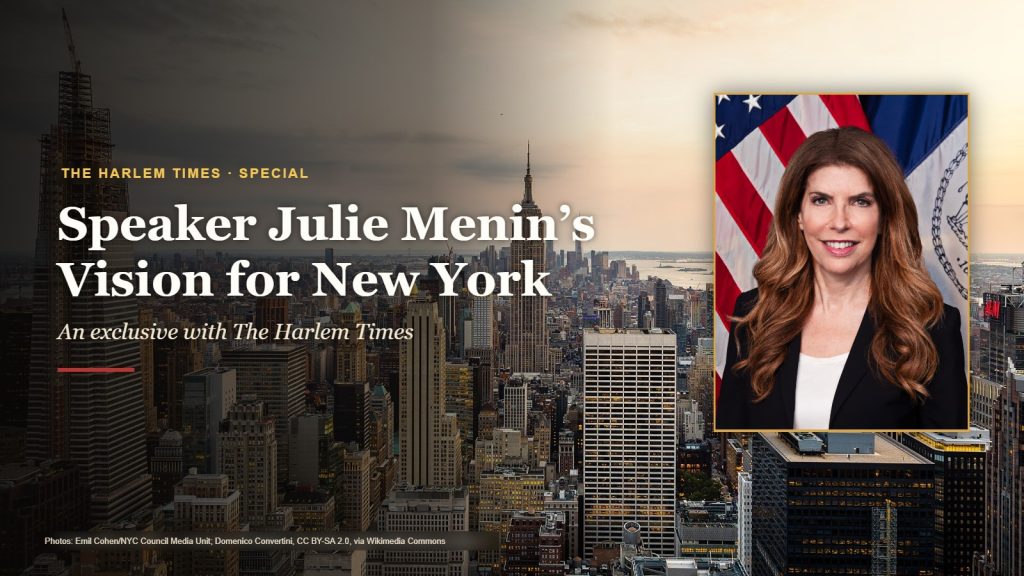
Top image: New York City Council Speaker Julie Menin. Photos: Emil Cohen/NYC Council Media Unit; skyline, Domenico Convertini, CC BY-SA 2.0, via Wikimedia Commons
A Harlem Times Special · Exclusive Q&A
“When the roots are deep, there is no reason to fear the wind.” — African proverb
From The Harlem Times: The second-most powerful office in New York City government belongs to the Speaker of the City Council, and right now that is Julie Menin. In the days after the Nov. 3 election, as voters across the country sent a message about the cost of living, we asked Speaker Menin five questions about what New Yorkers want, what Harlem needs, and how the city prepares its young people for an economy being remade by artificial intelligence. She answered them in writing for The Harlem Times.
From The Harlem Times: Her answers matter to papers like this one, too. As commissioner of the Mayor’s Office of Media and Entertainment in 2016, she announced a $1 million grant to the CUNY Graduate School of Journalism to help the city’s community and ethnic media outlets compete in the digital age. Last month, with Council Member Gale Brewer, she convened an oversight hearing on the city’s advertising spending with those outlets, which, by the Speaker’s own account, fell from a peak of $23.1 million in 2022 to about $7 million in 2024.
The Conversation
The Harlem Times: What did Tuesday’s election tell you about what New Yorkers want, and what will the Council do first?
Speaker Menin: Tuesday’s election demonstrated around the country what New Yorkers have known for a long time – we are ready for a change in priorities from the federal government. In response, as local leaders, we have a mandate to meet this moment and continue focusing on top issues for New Yorkers, like affordability and housing. Since the beginning, the Council has been fighting hard to deliver real, tangible solutions – like expanding Fair Fares and protecting the CityFHEPS housing voucher program – that make New Yorkers’ lives easier and help put money back in their pockets. Just this week, the Council passed a landmark bill to outlaw surveillance pricing in New York City, the strongest of its kind in the nation, which will help lower costs for New York consumers. That work does not stop or change, no matter who is in office at the federal level. We will continue to fight relentlessly for New Yorkers and work with our partners at all levels of government to deliver a better city.
The Harlem Times: What do Harlem and communities like it need most from city leaders right now?
Speaker Menin: New York is in the middle of an affordability crisis, and Harlem, like all communities across the city, is feeling the squeeze. What New Yorkers need most right now are elected officials who are responsive to the current moment – from skyrocketing housing prices and an ever increasing cost of living to emerging technologies that are rapidly reshaping the job market. New Yorkers need elected officials who are on the ground, in their communities, listening to what their constituents want and need, and are willing to roll up their sleeves and do the real work to pass actionable policy solutions that actually make a difference. That’s why this Council is insistent on moving quickly and taking decisive action when a crisis arises.
The Harlem Times: How do we prepare young New Yorkers for an economy being reshaped by AI?
Speaker Menin: AI is fundamentally changing the way we interact with the world, and protecting our city’s economy is a number one priority. New York City is fast becoming the technology and AI capital of the world, and we want to encourage the economic potential that new technologies can bring. But this cannot come at the expense of hard-working New Yorkers who are feeling the effects of a rapidly shifting economy. We as a Council have a responsibility to protect New Yorkers from the risks of AI, including economic risks, especially in the absence of federal action. This is why we are taking proactive action on the issue, calling a major hearing on the topic earlier this fall. During the marathon hearing, we heard testimony from Anthropic, Meta, Google, and OpenAI, as well as from experts in the field and members of the public about the potential risks of these emerging technologies, with the goal of passing carefully and thoughtfully developed legislation to regulate the industry while allowing New Yorkers to see its benefits.
Outside of legislative action and oversight, the Council plans to work with local businesses to empower them to take advantage of the AI revolution and remain competitive in an evolving market.
The Harlem Times: What partnership between government, business and community do you most want to build?
Speaker Menin: When city government and local businesses are working together, everyone benefits and our communities thrive. As Council Speaker, uplifting small businesses and empowering economic development has been one of my top priorities. As a former small business owner myself, I understand that community members understand better than anyone what is happening in their own districts. If we can facilitate communication between businesses, communities and the Council, we can ensure that the legislation we pass aligns with the lived experiences of our constituents. For example, this summer the Council passed a bill to make outdoor dining available year round, after hearing from local restaurant owners that assembling and disassembling outdoor dining sheds every year presented a major financial burden. This Council is committed to fighting for these kinds of investments and initiatives that strengthen our neighborhoods, support small businesses, and make New York City more affordable and more livable for everyone.
The Harlem Times: What would you say to young people in Harlem who voted for the first time on Tuesday?
Speaker Menin: To our young New Yorkers in Harlem who voted for the first time, I want to thank you for making your voice heard. Our city works best when our elected officials represent the diverse communities that they serve – including our young New Yorkers – and that cannot happen if we are not at the polls exercising our right to vote. Tuesday’s election was indicative of an increasingly engaged electorate, and one that young people are a crucial part of. Seeing our young New Yorkers participating in the democratic process makes me incredibly excited for the expansive possibilities that can emerge when we build diverse and active coalitions, especially as we look ahead to 2028 and even further to the 2030 Census – which will be another critical moment where the slimmest participation margins will make all the difference when it comes to congressional representation and federal funding.
What comes next
From The Harlem Times: For more conversations with the leaders shaping this moment, from City Hall to Capitol Hill, read our New Voices interviews with Congressman Glenn Ivey and Pennsylvania Lt. Gov. Austin Davis, and our coverage of Election 2026: A Year of Firsts.
Get stories like this in your inbox every Friday, free: subscribe to The Harlem Times Weekly. Share this conversation and tag us @HarlemTimesNews on X and @theharlemtimes on Instagram.