
“The one who asks questions does not lose the way.” — Akan proverb
At the edge of East Harlem, on the Mount Sinai campus along Madison Avenue, a new kind of workshop has opened its doors. According to a joint announcement from the Mount Sinai Health System and the New York City Economic Development Corporation (NYCEDC), Mount Sinai BioDesign’s Comprehensive Center for Surgical Innovation is now open: a $23 million center, spread across three facilities at The Mount Sinai Hospital, where surgeons, researchers, engineers and medical technology companies work side by side to design, test and advance new surgical devices.
An $11.6 million grant from NYCEDC’s LifeSci NYC initiative helped fund the center, the announcement says, alongside support from Mount Sinai’s Department of Neurosurgery, ventures launched through Mount Sinai BioDesign, and Health System donors.
From a doctor’s question to a working device
The idea, as Mount Sinai describes it, is to keep the whole journey under one roof, from the moment a clinician spots an unmet need to the day a device is ready for human clinical trials. The three facilities, according to the release:
- Mount Sinai BioDesign lab (Atran Building): design, prototyping and fabrication, with 3D printers and a computer-controlled machining tool, plus preparation for FDA review.
- Surgical Innovation Center and Human Anatomy Lab (Annenberg Building, 12th floor): robotic and digitally integrated surgical suites for simulation and device testing.
- Pre-Clinical OR Angio Suite (Annenberg Building, 26th floor): an imaging-enabled operating room for evaluating devices and surgical systems before any testing in patients.
BioDesign, launched by Mount Sinai’s neurosurgery department in 2014, is currently validating and testing more than 15 innovation concepts across more than 10 areas of health care, according to the announcement.
“By investing in state-of-the-art facilities that bring together our clinicians, researchers, and engineers with medical device companies, we have built the complete medtech pipeline under one roof.”
Dr. Brendan G. Carr, CEO, Mount Sinai Health System
“New York City is at its best when it invests in spaces where ideas meet opportunity.”
Jeanny Pak, Chief Operating Officer, NYCEDC
Jobs and a talent pipeline
Both partners frame the center as an economic engine as well as a medical one. Pak said it will “grow our life sciences sector, create good jobs, and make sure the future of medicine is built here in New York.” NYCEDC places it alongside SPARC Kips Bay, a planned life sciences education and career hub, and NYU’s new quantum fabrication facility, which the city says will offer training pathways for CUNY and public school students.
For young New Yorkers uptown thinking about careers in engineering, medicine or health technology, the message is that this work is being done a short walk from home. The next step for the community is to make sure the jobs and training those investments promise reach the young people who live closest to them.
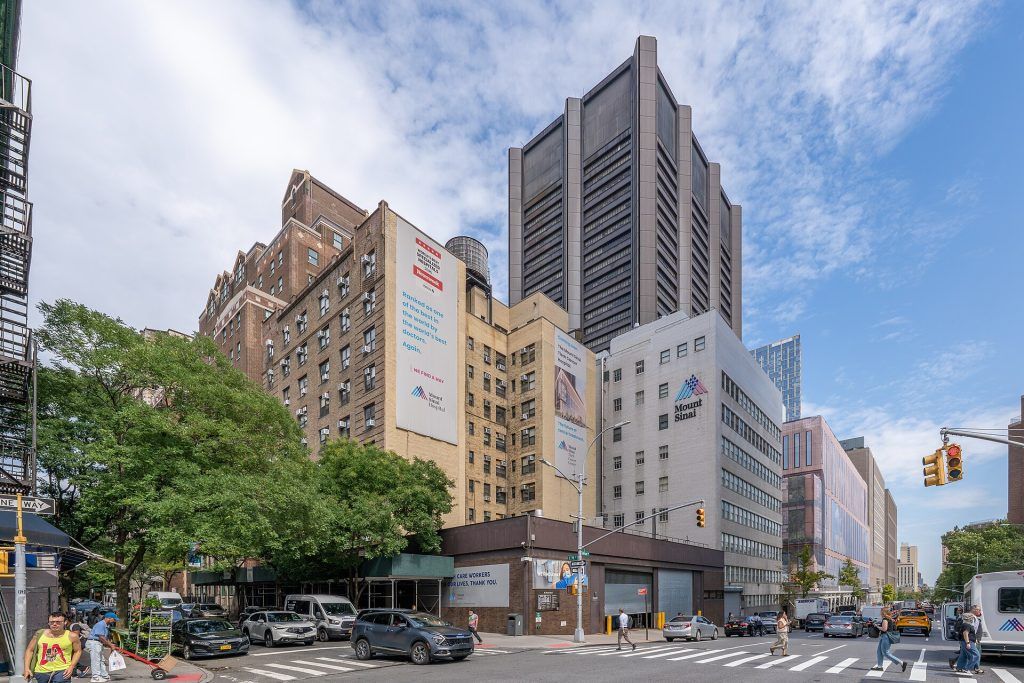
Featured photo: The Mount Sinai Hospital campus on Madison Avenue near East 99th Street, with the Annenberg Building rising behind. Photo: Ajay Suresh, CC BY 4.0, via Wikimedia Commons.
Sources and attribution: facts, figures and quotes are from the joint press release issued by NYCEDC and the Mount Sinai Press Office. All other text, including analysis, is by The Harlem Times. Prepared by THT Events Desk at THT Media Lab with AI assistance and published under the editorial direction of The Harlem Times.
Know a student who dreams of building the future of medicine? Share this story and tag @HarlemTimesNews on X and @theharlemtimes on Instagram.